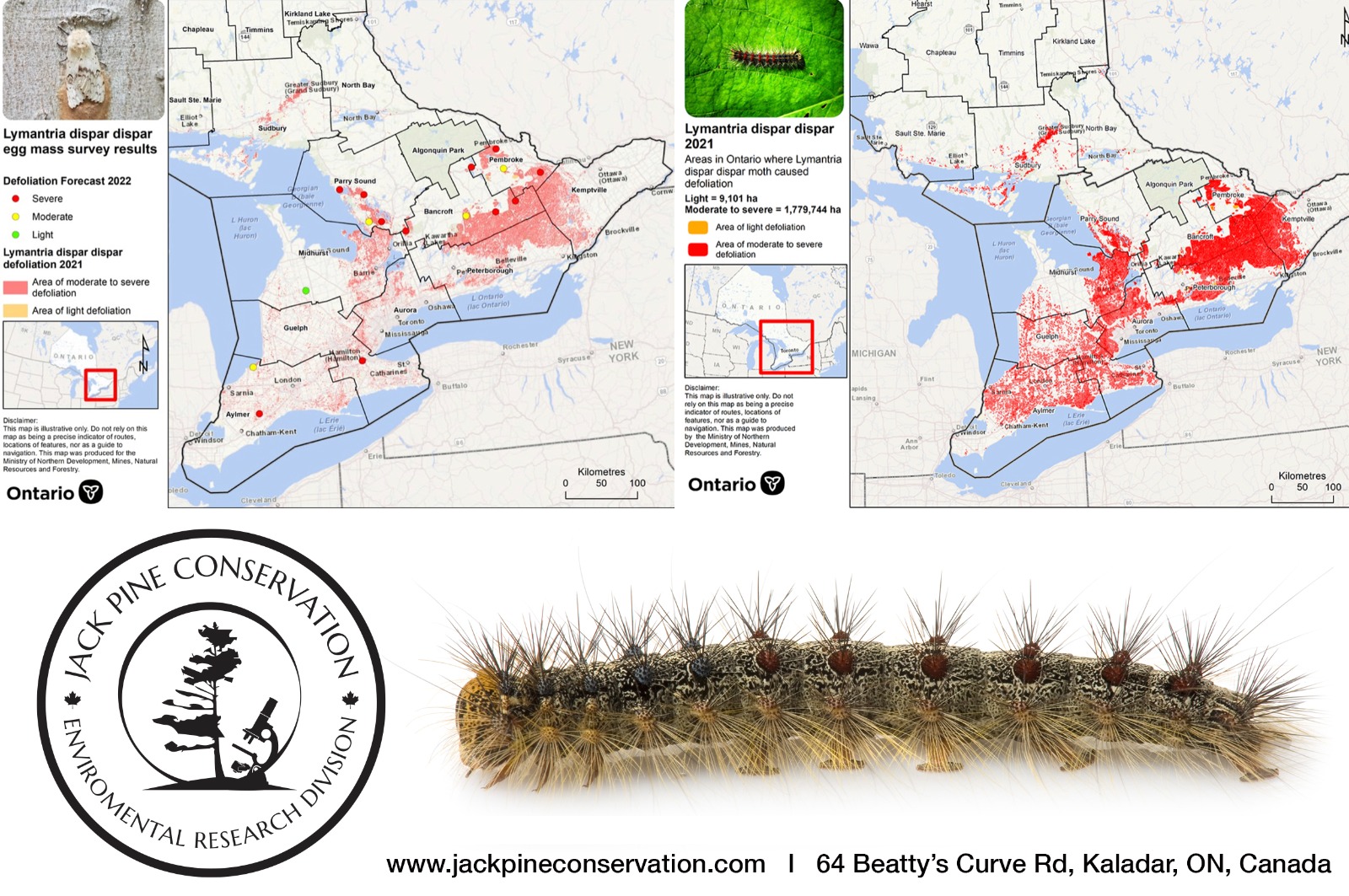
Gypsy moth (lymantria dispar) are not new to London folk. Once a native species in the wetlands of eastern England, the moth was extinct after being drained out in the early 1900’s. UK had a native population that thrived on bog-myrtle (Myrica gale) and creeping willow (Salix repens) which maintained itself in a balanced ecosystem. However, in 1995 near north-east London, a heightened outbreak emerged with the source remaining unknown. Possibilities of vehicle transportation through wood crates or imported timber were most likely the means as female moths have limited range while the eggs attach to many surfaces.
Regardless, one thing that is for certain is the rise in population affecting more than the people of England. Widespread across the world, nations have seen significantly damaging defoliation with 2021 being the worst year to date. We asked conservationist Kyle X. Mufti, founder of the Jack Pine Conservation Estate located in ON, Canada to shed some light on the matter following his environmental nomination in Hampshire of 2019.
“Invasive species pose both economic and ecological threats to our forests. For a comparison, there were 350,000 hectares of defoliation in 1985 and 580,000 hectares of defoliation in 2020. In 2021 we’ve seen three times that amount with more than 1.7 million hectares affected and possibly another record-breaking year in 2022. Our goal is to fundraise and work alongside organizations that will help keep Ontario green by proposing solutions for future cycles.”
Kyle X. Mufti received an honorary degree from the University of Southampton for his philanthropic work with the Jack Pine Conservation Estate after conserving the protected land in 2017. The land was initially identified as an International Biological Preserve (IBP) site in 1974, and then subsequently identified as a provincially significant Area of Natural Scientific Interest (ANSI) in the Ministry of Natural Resources. The landscape is an ideal environment to study varying ecosystems and an especially susceptible and unique area to research the gypsy moth with more than 90% of the growth being oak trees.
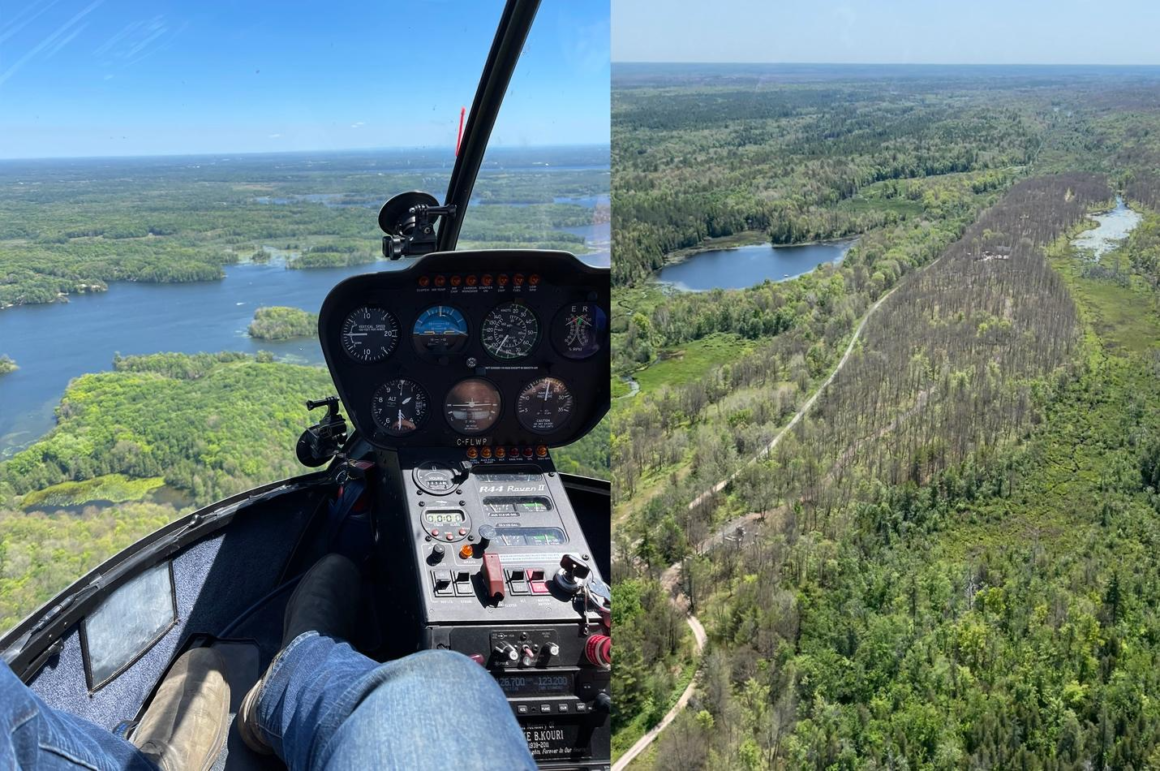
Kyle X. Mufti and volunteers monitoring damages in Kaladar, ON | Image: Jack Pine Conservation Estate
The staggering results of helicopter monitoring show a barren forest state in the middle of July. Over 1000 hectares were subject to severe defoliation at the Kaladar Jack Pine Barren Reserve in ON, Canada. The question at large for many is how will climate change affect future cycles? Following years will determine its trajectory as 2021 was the “perfect combination of elements” according to Mr. Mufti with warm winter temperatures and dry spring conditions. The eggs are unable to survive consecutive days of freezing and die at a steady temperature below −26°C. The rate of freezing at steady temperature is about 1% per min at −27°C, changing about tenfold per degree.
So, without colder winters, what can be done? As part of ongoing gypsy moth control programs, many Ontario cities are combining ground sprays, tree injections, aerial spraying and scraping egg masses off the trees. The Jack Pine Conservation Estates has recruited a large number of volunteers to scrap egg masses this spring as well as monitor egg mass temperatures throughout various biomes.

Kyle X. Mufti, Michelle Crewe, Jennifer Muffty conducting aerial helicopter research from the Jack Pine Conservation Estate’s facility July 2021 | Image: Jack Pine Conservation Estate
For the full report and to learn more about what you can do to manage the gypsy moth and other invasive species, visit www.jackpineconservation.com or follow @jackpineconservation on Facebook and Instagram.