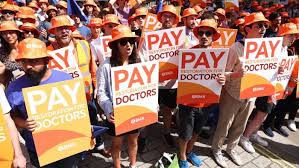
Independent Analysis Contradicts Government’s Narrative on Wage Restoration
As 5,000 resident doctors prepare for another round of strike action on Friday, July 25, a new report from the Nuffield Trust reveals that their pay remains 4% to 10% below 2010-11 levels, reigniting the national debate on fair wages in the NHS. The British Medical Association (BMA), however, continues to demand a 29% “full pay restoration”, arguing that their wages have fallen drastically in real terms since 2008-09.
This Friday’s strike will mark the 12th walkout since 2023, underscoring the ongoing deadlock between medical professionals and the UK government. As the dispute intensifies, the fallout is poised to affect not only healthcare services but also the broader UK economy, which Barclays Bank warns could flatline in Q3 due to lost working days.
BMA vs Nuffield Trust: A Battle of the Baselines
Why the Numbers Don’t Add Up
The heart of the pay debate lies in conflicting data sources and inflation measures:
-
The BMA uses the Retail Price Index (RPI), which includes housing costs and is generally higher, claiming a 29% drop in real earnings since 2008-09.
-
The Nuffield Trust, using the Consumer Price Index (CPI) and a 2010-11 baseline (when data collection methods changed), estimates a 4-10% real-terms drop.
The think tank argues its methodology is more robust and reflects a clearer economic picture, avoiding “flawed figures” and “conflated” pay definitions. However, the BMA counters that RPI better reflects real-life costs faced by doctors—such as student loan repayments, vehicle taxes, and travel fare caps—making it the fairer metric for assessing wage erosion.
“Whatever measure you use, doctors’ pay has fallen over the last 15 years and more,” a BMA spokesperson emphasized.
Government Response: Pay Offer Rejected, Loan Forgiveness Floated
In response to ongoing demands, Health Secretary Wes Streeting has criticized the 29% ask as “completely unreasonable,” pointing to a 22% pay increase already provided over 2023-24 and 2024-25.
To sweeten negotiations, Streeting offered student loan forgiveness—a potentially valuable concession, considering doctors often graduate with £100,000 or more in student debt. Talks, however, collapsed without resolution, leading to the upcoming strike.
What Are Resident Doctors Actually Earning?
The Nuffield Trust’s data, based on NHS salary figures to March 2026, shows the following:
Resident Doctors (First-Year Postgraduate Trainees)
-
Basic Salary: £38,831
-
Total Average Salary (with top-ups): £45,900
Specialty Registrars (Post-Training)
-
Basic Salary Range: £52,656 – £73,992
-
Total Average Salary: Up to £80,500
NHS Consultants
-
Starting Basic Salary: £109,725
-
Senior Consultants (14+ years): £145,478
-
Total Salary with Allowances: Up to £161,600
GPs (2022-23 Estimates)
-
GP Partners: ~£163,500
-
Salaried GPs: ~£108,300
These figures place resident doctors slightly above the median national earnings, while registrars and consultants fall within the top 10% to 2% of earners in the UK.
“For 2024-25, the average NHS earnings of doctors in their first year of work was above the median,” the report confirmed.
NHS Strain: Strikes Threaten Routine Care
With Friday’s strike imminent, NHS England has urged hospitals to maintain routine operations and appointments unless patient safety is directly compromised. But this guidance has provoked backlash from the BMA.
“Delivering non-urgent planned care on strike days will leave staffing levels unsafe across the board,” warned Dr Tom Dolphin, BMA Council Chair.
The BMA insists that emergency and urgent care should take precedence during the industrial action. Meanwhile, Prof Meghana Pandit, NHS England’s National Medical Director, acknowledged the strain but said hospitals are “doing all we can” to protect patient care.
Economic Ripples: Barclays Warns of Q3 Growth Stagnation
Economists at Barclays estimate that the latest strike could result in 250,000 lost working days, shaving 0.1 percentage points off expected growth for Q3. With the bank’s original forecast at just 0.1%, that loss could wipe out all growth, leaving the UK economy flatlined.
“There is a heightened risk the strike could reduce growth to zero,” the bank’s analysts noted.
This economic impact places even greater pressure on the government to resolve the dispute swiftly—especially as economic resilience remains fragile amid broader post-pandemic and inflationary pressures.
The Long View: Pay Cycles of Boom and Bust
The Nuffield Trust report notes that doctor pay trends over the past four decades reflect alternating periods of real-term increases and decreases. Interestingly, current earnings for senior roles like consultants and GPs are strong when compared to inflation going back to the late 1990s and early 2000s.
But for early-career doctors, the story is less optimistic. Resident doctors have felt the brunt of pay stagnation, particularly during the austerity years of 2010–2020. The report also points out that people are loss-averse by nature, meaning pay cuts feel far more significant than equivalent raises.
What Comes Next?
As the BMA braces for Friday’s strike and the government digs in on its rejection of the 29% demand, the question remains: Will compromise emerge or confrontation deepen?
With broader implications for healthcare delivery, workforce morale, and national economic performance, the stakes of this dispute reach far beyond hospital corridors. Policymakers, health executives, and industry leaders will be watching closely—not just for short-term disruption, but for signs of a deeper restructuring of public sector pay in the UK.