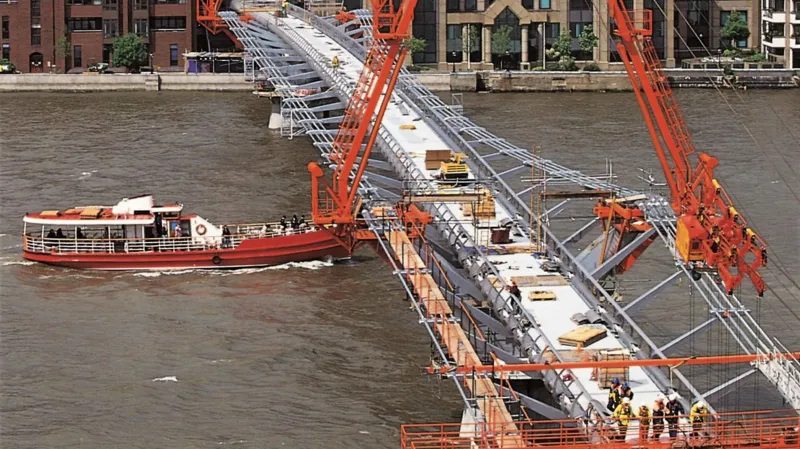
The Bridge That Wobbled: A 25-Year Journey
On 10 June 2000, London’s Millennium Bridge opened to great fanfare, connecting St Paul’s Cathedral to the Tate Modern across the River Thames. Within just three days, it gained worldwide infamy—not for its sleek design, but for an unexpected and unsettling wobble that led to an immediate closure.
Now, 25 years later, the “Wobbly Bridge” has transformed from an engineering embarrassment into one of London’s most beloved landmarks.
The Birth of the Millennium Bridge
A Competition That Shaped London’s Skyline
The Millennium Bridge was born out of a 1996 design competition led by the Millennium Bridge Trust, supported by the Financial Times, the Royal Institute of British Architects, and Southwark Council. The winning design came from a collaboration between architectural powerhouse Foster + Partners, renowned sculptor Sir Anthony Caro, and engineering firm Arup.
Lord Foster’s vision was a minimalist “blade of light” that would avoid obstructing views of St Paul’s Cathedral. Early sketches, famously drawn on the back of a napkin in a London wine bar, laid the foundation for what would become one of the city’s most photographed pedestrian crossings.
A Long-Delayed Dream
The idea of a footbridge over this part of the Thames dates back to the 1850s, but plans were repeatedly shelved over the decades due to concerns about disturbing St Paul’s Cathedral or the lack of public support. The modern project, finally approved in the 1990s, marked the first new Thames bridge since Tower Bridge opened in 1894.
The Grand Opening—and Immediate Shutdown
A Crowded Debut
When the Millennium Bridge officially opened on 10 June 2000, nearly 90,000 excited pedestrians crossed it in a single day. Among the attendees were celebrities such as Julia Somerville, Chris Bisson, and H from the pop group Steps. Queen Elizabeth had dedicated the bridge just a month earlier, setting high expectations for the structure’s debut.
The Wobble Heard Around the World
Within moments, it became clear something was wrong. The bridge visibly swayed under the synchronized footsteps of the crowd. The phenomenon, later diagnosed as “synchronous lateral excitation,” occurred because pedestrians unconsciously matched their pace to the bridge’s natural movement, amplifying the swaying.
By Monday evening—just three days after opening—the bridge was closed indefinitely for a full engineering investigation.
Engineering the Solution
The Fix: Dampers and Redesign
After 18 months of intensive analysis, engineers fitted the bridge with 37 fluid-viscous dampers and 52 tuned mass dampers, similar to shock absorbers, to mitigate the wobble. These additions successfully stabilized the bridge, allowing it to safely reopen on 22 February 2002 under the stewardship of the City Bridge Foundation.
Chris Wise, one of the bridge’s original designers, reflected on the episode with humility and pride:
“I did feel very responsible, but I don’t recall any sense of crisis – it was more fascination: what’s the problem and what can we do about it?”
A London Icon Emerges
Part of the City’s Fabric
Today, the Millennium Bridge is not just a river crossing—it’s a vital part of London’s cultural landscape. Chair of the City Bridge Foundation, Paul Martinelli, emphasizes its transformation:
“A quarter of a century after it opened, it’s now hard to imagine this stretch of the Thames without Millennium Bridge. It has become a true London icon.”
The bridge’s sleek profile, unobstructed views, and cultural significance have made it a magnet for tourists, photographers, and filmmakers alike.
Hollywood Spotlight
The Millennium Bridge has graced the big screen in major films like Guardians of the Galaxy and Run Fatboy Run, but it is perhaps best known for its dramatic destruction scene in Harry Potter and the Half-Blood Prince, where Death Eaters collapse the bridge in a memorable cinematic moment.
Celebrating 25 Years
A Milestone Marked with Poetry and Cake
On 11 June 2025, the City Bridge Foundation celebrated the bridge’s 25th anniversary with a cake-cutting ceremony held directly on the bridge. Visitors can also discover a commemorative poem via QR codes placed along the walkway.
From a shaky start to a shining symbol, the Millennium Bridge’s journey is a testament to London’s ability to turn setbacks into successes.
Fast Facts About the Millennium Bridge
-
Length: 1,066 feet (325 meters) – approximately three football fields
-
Width: 13 feet (4 meters)
-
Height: 35 feet (10.8 meters) above the Thames at high tide
-
Design: Suspension bridge with a minimal profile, creating an unobstructed visual corridor
-
Engineers: Foster + Partners and Arup
-
Original Opening: 10 June 2000
-
Reopening: 22 February 2002
What began as a structural flaw became a defining feature in the story of the Millennium Bridge. Rather than being a source of lasting shame, its “wobble” has become part of its charm and history. The bridge now stands as a powerful example of modern engineering, creative problem-solving, and the resilience of public infrastructure.
For the City of London and its millions of visitors, the Millennium Bridge is no longer just a pathway across the Thames—it’s a journey through time, design, and urban storytelling.