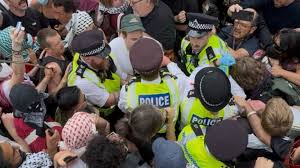
Crackdown in Liverpool: Protest Turns Into Anti-Terror Arrest Scene
A routine pro-Palestine march in Liverpool escalated into a terrorism investigation on Sunday, as four individuals—some elderly—were arrested for allegedly displaying support for the recently banned activist group Palestine Action.
The arrests come amid a nationwide surge in detentions linked to pro-Palestinian demonstrations, raising fresh questions about the UK’s civil liberties, freedom of expression, and the increasingly politicized application of anti-terror laws.
What Happened in Liverpool?
From Peaceful Protest to Police Intervention
The protest, part of a regular march organized by Liverpool Friends of Palestine, was disrupted when Merseyside Police reported that some attendees were seen with material supporting Palestine Action, a group officially proscribed as a terrorist organization last month.
Four individuals—a 74-year-old woman from Kensington, a 65-year-old man from Brighton-le-Sands, a 28-year-old man from Garston, and a 72-year-old man from Mossley Hill—were arrested under the Terrorism Act 2000, accused of wearing or carrying articles in support of the banned group.
They were taken to local police stations for questioning. No formal charges had been announced at the time of writing.
Who Is Palestine Action and Why Were They Banned?
The RAF Brize Norton Incident That Triggered a Ban
The group was outlawed on June 23, three days after an attack on two Voyager aircraft at RAF Brize Norton, allegedly carried out by Palestine Action operatives. The attack caused an estimated £7 million in damage, and Home Secretary Yvette Cooper described it as “disgraceful”.
Citing the group’s “long history of unacceptable criminal damage”, Cooper announced that supporting or being a member of Palestine Action would now carry penalties of up to 14 years in prison.
The decision was widely condemned by civil liberties groups, who say it blurs the line between legitimate protest and terrorism.
Arrests Nationwide Signal Coordinated Crackdown
Nearly 100 Detained in Protests Across the UK
Sunday’s arrests in Liverpool were part of a broader nationwide effort. Police detained over 100 individuals at coordinated protests across cities including:
-
London (55 arrested) – Parliament Square demonstrators were detained for holding signs supporting Palestine Action.
-
Manchester (16 arrested) – Greater Manchester Police confirmed they were investigating potential links to proscribed activities.
-
Truro (8 arrested) – Activists protesting near Truro Cathedral were taken into custody.
-
Bristol (17 arrested) – Avon and Somerset Police made further arrests as tensions rose.
All protests were reportedly linked to a campaign coordinated by Defend Our Juries, a civil liberties group now under intense scrutiny.
A Chilling Effect on Protest?
Civil Liberties Advocates Sound the Alarm
Legal and civil rights organizations have expressed deep concern over the arrests, particularly involving elderly protesters.
“This is a chilling escalation,” said one civil rights barrister, speaking anonymously. “We are witnessing the criminalization of protest under anti-terror laws—a dangerous precedent.”
Others warned that prosecuting senior citizens under terrorism statutes for holding placards could alienate mainstream supporters of Palestinian human rights and embolden authoritarian tendencies in UK governance.
The Political Risk for Labour’s Yvette Cooper
Home Secretary Balances Security and Public Opinion
Yvette Cooper’s decision to proscribe Palestine Action was intended to project strength and decisiveness on national security. But it risks blowback from Labour’s base, which includes many pro-Palestinian supporters, especially in urban centres like Manchester, Birmingham, and London.
By drawing a hard line on Palestine Action, Cooper and Labour may be perceived as adopting Tory-era tactics, undermining their progressive credentials.
A former Labour MP noted, “If Labour continues down this road, they may win over centrists, but they’ll risk hemorrhaging support from younger and minority voters.”
What Happens Next?
Legal Battles and Political Consequences
All arrested individuals remain under investigation. Legal experts anticipate a wave of challenges to the arrests under human rights and freedom-of-expression laws.
Meanwhile, activist groups vow to continue demonstrating, claiming that peaceful advocacy is being reframed as extremism.
The broader question is whether this represents a temporary public order crackdown—or a long-term shift in how the UK handles dissent.
A Nation at a Crossroads
The UK is now grappling with a difficult question: Where is the line between protest and terrorism?
Sunday’s arrests show how easily that line can move—and how quickly ordinary citizens, including pensioners, can find themselves facing serious criminal charges for symbolic political expression.
For CEOs, policymakers, and political observers, the message is clear: civil unrest in response to Middle East policy is becoming a high-risk flashpoint, and government responses are shifting from tolerance to enforcement at speed.
Whether this sharp turn toward criminalization of protest becomes the new normal—or ignites a backlash of its own—remains to be seen.